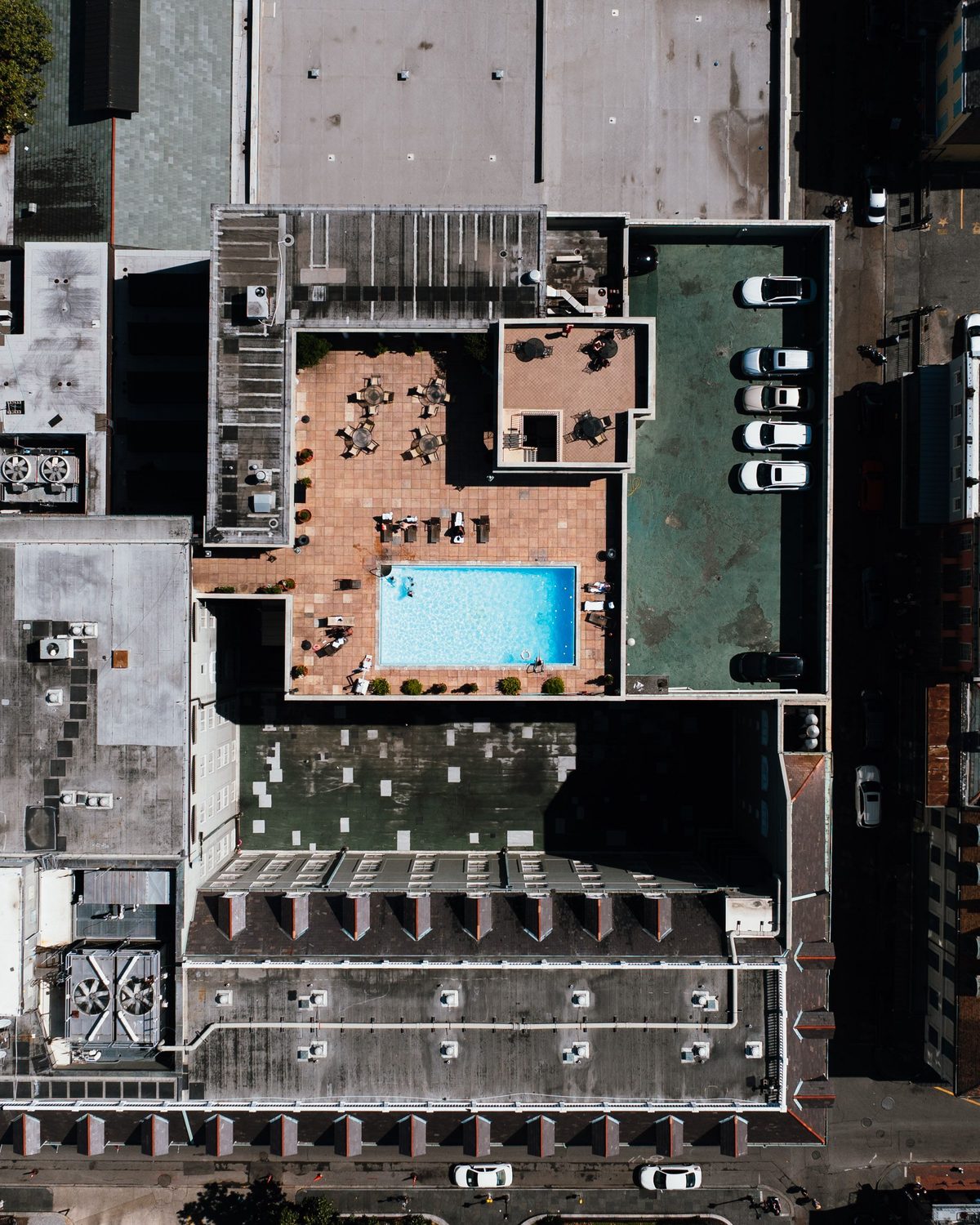
This is a checklist for an annual commercial roof inspection. It covers the walk itself and, just as importantly, what has to be recorded so that next year’s inspection can be compared with this one.
A single inspection describes a roof. A series of them predicts one.
Set up once, then never change it
| Fix | Why |
|---|---|
| A numbered roof plan | Every finding needs a location that survives the visit |
| An area numbering scheme | By level, system or construction date |
| A fixed walking route | Comparability depends on it |
| Standing photograph positions | Marked on the plan, repeated every year |
| A rating scale | Three levels, defined in the report |
| A report structure | The same sections, in the same order, every year |
The roof
| Look at | What a problem looks like |
|---|---|
| Drainage | Blocked outlets, missing strainers, standing water, no overflows |
| Perimeter and edge metal | Open joints, lifted sections, loose bars, staining below |
| Upstands and parapets | Membrane pulling away, a gap at the top, a slumped corner |
| Seams and laps | Edges lifting, dirt lines, steps, hand applied mastic |
| Penetrations and collars | Split at the top, clamps missing, standing away from the pipe |
| Curbs and flashings | Slipped, sealed with mastic at the corners, fixings through the membrane |
| The open field | Splits, punctures, scuffs, blisters, dropped material |
| Surfacing | Bare patches, granule loss, chalking, wear on the routes |
| Walkways | Missing, worn, or ending short of where people walk |
| Rooflights and hatches | Cracked, crazed, flashing lifted, a hatch not closing |
The equipment
| Look at | What a problem looks like |
|---|---|
| Units and stands | Bearing on the membrane, pads moved or crushed |
| Condensate discharge | Running onto the roof, a permanently damp patch |
| Cable trays and conduit | Resting on the membrane, fixings through the roof |
| Solar arrays and screens | Debris at the upwind edge, ballast moved, worn membrane |
| Panels and covers | Open, propped, or no longer fastening |
| Evidence of recent work | New fixings, offcuts, sealant, unexplained scuffs |
Inside the building
| Look at | What a problem looks like |
|---|---|
| Ceilings and finishes | New stains, stains that have grown, sagging tiles |
| The deck where visible | Damp, rust lines, drips along a beam |
| Insulation in the void | Damp, compressed, displaced or stained |
| Plant rooms | Trays, buckets or diverters somebody has accepted |
| Light fittings | Water near a fitting, which is a safety issue first |
| Occupant reports | Where it dripped this year, and in what weather |
The record
| Capture | Why |
|---|---|
| Findings against area numbers | So they can be found again and priced |
| Two photographs per finding | Wide to place it, close to show it |
| The standing photographs | Even where nothing is wrong, especially then |
| A rating per area and per finding | A fair roof can carry an urgent detail |
| What changed since last year | The most useful section in the report |
| Actions taken since last year | Whether last year’s findings were dealt with |
| Remaining life, with its basis | Condition or age, in one word |
What to do with it
- Walk the same route every year. Comparability is the whole point.
- Take the standing photographs even when nothing is wrong. Especially then.
- Write what changed, not only what is there. Three sentences will do.
- Check last year’s actions were done. Findings repeat until somebody acts.
- Book next year’s date before you file this year’s report. It stops being a decision.
Want the reasoning behind this? Read what an inspection program covers and what the service includes.
Walked by Date Roof
Common questions
Why annual rather than when something goes wrong?
Because by the time something goes wrong the cheap window has closed. A blocked outlet costs nothing to clear and a ceiling to ignore, and the same holds for an open lap, a split collar and a loose edge bar. Annual inspection is how those get found while they are still small.
- Nearly every expensive roof failure began as a cheap one
- Most warranties require documented inspection anyway
- An annual record is what makes a capital plan defensible
- Comparison between years is the only way to see a trend
- Reactive repair always costs more than planned repair
There is also a quieter benefit. A roof that is inspected gets walked by somebody competent once a year, which changes the behavior of everybody else who goes up there. Service engineers are noticeably more careful on a roof where somebody is known to be looking, and a good proportion of roof damage comes from exactly that traffic.
What makes one year comparable with the next?
The same route, the same area numbering, the same rating scale and the same standing positions for photographs. Change any of those and you have two descriptions of a roof rather than a record of how it has changed, which is the only thing that predicts anything.
- A fixed route, written into the checklist
- Area numbering that never changes once set
- A rating scale defined in the report and reused
- Standing photographs repeated from the same positions
- The same report structure every year
The standing photographs are the part most often dropped, because photographing an area that looks fine feels pointless on the day. It is the most valuable thing in the file three years later. A picture of a sound seam today is what proves exactly when it stopped being sound, and that is frequently the difference between a warranty claim that succeeds and one that does not. Keep the plan and the photographs in one folder that survives a change of facilities manager, which is the commonest way a record quietly ends.
When in the year should it happen?
Before the wet season rather than after it, so that what you find can still be fixed in good weather. In most places that means autumn, with a shorter spring walk to see what the winter did and to catch anything that moved.
- Autumn, so drainage is clear before the wet season
- Spring, as a shorter walk, to see what winter did
- After severe weather, whatever the schedule says
- After any work by a trade other than roofing
- Avoid scheduling it in the season you cannot repair in
Fix the date in the calendar a year ahead rather than deciding each time, because an inspection that depends on somebody remembering is an inspection that happens after the leak. Tie it to something that already recurs, such as the plant service visit or the start of a budget cycle, and it stops being a decision anybody has to make. Allow four to six weeks between the inspection and the weather you are preparing for, so there is time to get the work done.
What should the annual report contain?
A located and photographed finding list, a rating per area and per finding, a comparison with last year, a recommended action with a timescale against each item, and a short statement of what has changed since the previous inspection. It should also say whether last year's recommendations were carried out, which is the question nobody asks.
- Findings located on a numbered plan
- Two photographs per finding, wide and close
- A comparison section against the previous year
- Recommended actions with timescales
- A remaining life figure, with its basis stated
- A statement of whether the previous year's actions were completed
The comparison section is what distinguishes an annual report from a first report. It should say plainly what is new, what has grown, what was repaired and what has not changed. Three or four sentences are enough, and they are the part that a finance director will actually read before deciding whether to fund anything. Keep it short enough that somebody will read it. A forty page report with the findings buried in it is a report that gets filed rather than acted on.
Who should carry out the annual inspection?
Somebody competent who is not the contractor who will quote for the remedial work, where that can be arranged. It is not that contractors are untrustworthy, it is that the roles pull in different directions and separating them removes the question entirely.
- Independence removes an argument before it starts
- The inspector should hold their own professional indemnity
- Experience with this system type matters more than a certificate
- The same inspector each year improves the comparison
- Internal walks between visits are useful and cheap
Where budget makes independence impractical, the workable compromise is an internal walk by the facilities team twice a year using a written checklist, with a professional inspection every second or third year. That keeps a record running continuously and brings in an expert eye at intervals, which is far better than nothing and much cheaper than annual independence. Whoever does it, keep the same person for several years running, because familiarity with the building is worth more than a fresh pair of eyes on a roof with a history.