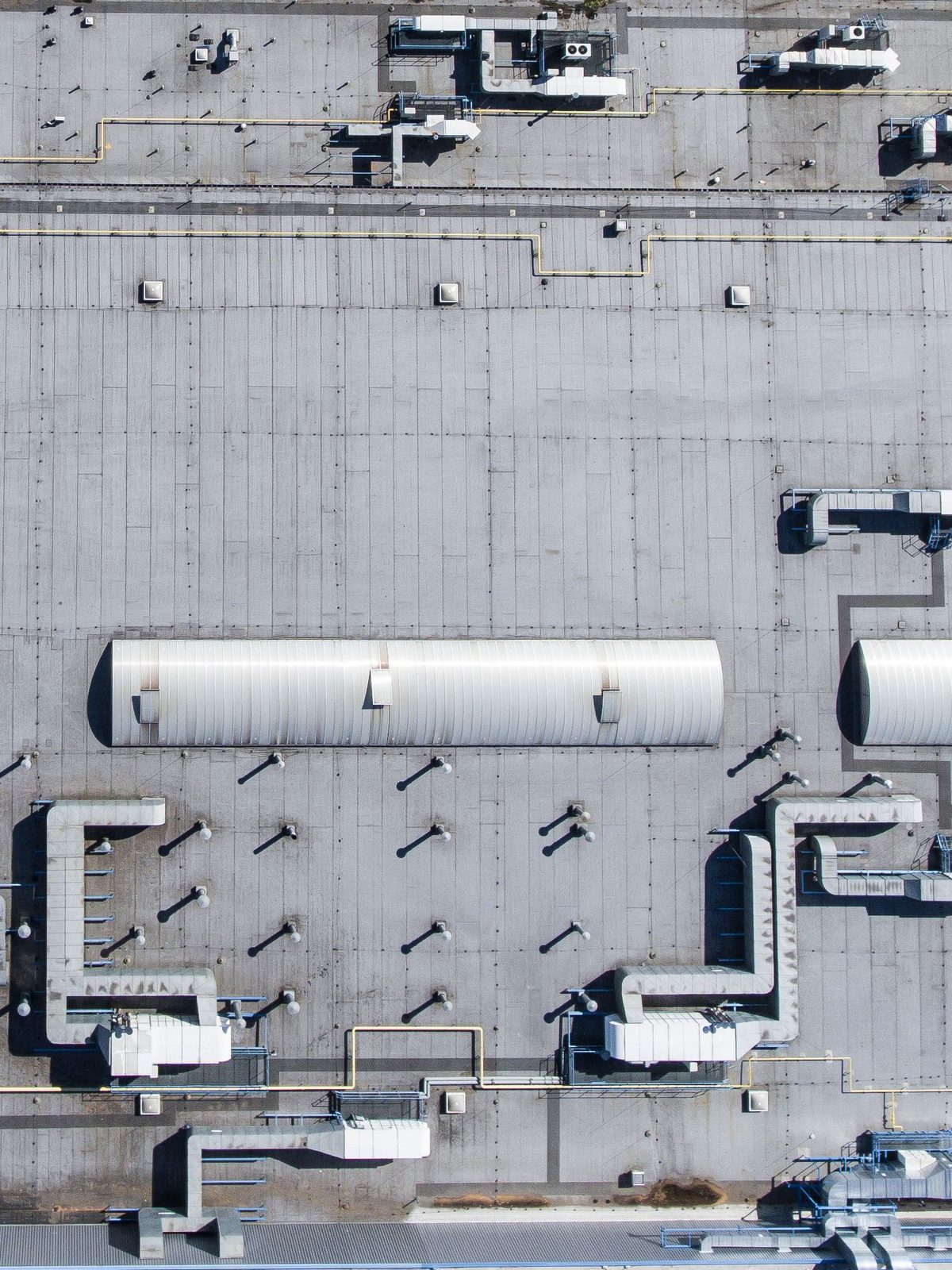
This is a roof inspection checklist for a retail center, a parade or a standalone store. It assumes tenant units under a shared roof, which is where most of the complications come from.
Read the leases before you go up. On this building type, responsibility is the first question and the roof is the second.
Before you go up
Establish from the leases who is responsible for which roof areas, who must be notified, and who may go on the roof at all. Take a roof plan marked with the unit boundaries.
Note which units have changed hands recently, and which have been fitted out in the last two years.
The tenant penetrations
| Look at | What a problem looks like |
|---|---|
| Extract and refrigeration penetrations | Mastic as the only detail, a collar standing away |
| Curbs added for later units | Gaps at the corners, flashing slipped, upstand too low |
| Cable and data runs | Cut in later, resting on the membrane, fixings through the roof |
| Signage and fascia fixings | Driven through the edge detail or the upstand |
| Abandoned penetrations | Capped with whatever was to hand, then forgotten |
| Condensate discharge | Running onto the membrane, a permanently damp patch |
The shared roof
| Look at | What a problem looks like |
|---|---|
| Drainage | Blocked outlets, missing strainers, standing water, no overflows |
| Gutters and valleys | Debris, moss, sagging, open joints |
| Seams and laps | Edges lifting, dirt lines, hand applied mastic |
| Perimeter and edge metal | Open joints, lifted sections, loose bars, staining below |
| Parapet upstands | Membrane pulling away, a gap at the top |
| The open field | Splits, punctures, blisters, scuffs, dropped material |
| Walkways | Missing, or ending short of the equipment people service |
| Party walls between units | Upstands and flashings at a boundary nobody owns |
The equipment
| Look at | What a problem looks like |
|---|---|
| Rooftop units by unit | Which tenant owns each one, and who services it |
| Unit bases and stands | Bearing on the membrane, pads moved or crushed |
| Grease extract, where present | Staining downwind, a greasy film, containment missing |
| Panels and covers | Open, propped, or no longer fastening |
| Vibration damage | Fixings worked loose, sealant cracked at a base |
| Evidence of recent work | New fixings, offcuts, sealant, unlogged access |
Inside the units
| Look at | What a problem looks like |
|---|---|
| Sales floor ceilings | Stains, sagging tiles, water marks near a penetration |
| Stock rooms | Damage nobody has reported, often the first place it shows |
| Service corridors and plant | Trays, buckets, standing water |
| Shopfront and fascia junctions | Damp at the head of the shopfront |
| What the unit managers say | Where it drips, and in which weather |
The paperwork
| Keep | Why |
|---|---|
| Leak history by unit | Three leaks over one unit is a case; three findings are not |
| A fit out roof procedure | The highest value document a retail landlord can write |
| A record of every penetration | Added to the plan when it is created, not found later |
| Lease responsibilities, summarized | So nobody has to read a lease during a leak |
| An out of hours contact route | Agreed before it is needed |
What to do with it
- Read the leases first. Responsibility is the first question on this building type.
- Walk the tenant penetrations as a separate pass. This is where it leaks.
- Issue a roof procedure with every fit out pack. One afternoon, enormous return.
- Inspect after every fit out. Tie it to the final sign off.
- Keep the leak history by unit. It is what funds remedial work.
Want the reasoning behind this? Read how building type changes the roof and what the inspection service covers.
Walked by Date Roof
Common questions
What makes a retail roof different?
Divided responsibility. A retail center roof usually covers several tenancies with different leases, different fit outs and different rooftop equipment, so the question of who inspects, who repairs and who pays is rarely as simple as the roof plan makes it look.
- Multiple tenancies under one continuous roof structure
- Leases that allocate roof responsibility differently from one another
- Tenant fit outs that have added penetrations over the years
- Equipment installed by tenants with no roofing detail
- A leak over stock that becomes a commercial claim immediately
Read the leases before the roof. They determine who can go up, who pays for what, and who has to be told before anything happens, and on an older center the answers frequently differ between units. An inspection carried out without that knowledge produces findings nobody is clearly responsible for acting on. Summarize the roof clauses from every lease onto one page and keep it with the roof plan, so nobody is reading a lease during a leak.
Where do retail roofs usually leak?
At tenant penetrations, almost always. Extract fans, refrigeration lines, cable routes and signage brackets added during a fit out, each installed by a trade other than roofing and each one a path through the membrane that was never detailed properly.
- Extract and refrigeration penetrations from unit fit outs
- Signage and fascia fixings driven through the roof edge
- Cable and data runs cut in later
- Curbs added for new units, sealed with mastic at the corners
- Abandoned penetrations from a previous tenant, capped and forgotten
Abandoned penetrations are worth looking for specifically. When a unit changes hands the new fit out adds its own services and the old ones are frequently left in place, capped off with whatever was to hand. Over a decade a center can accumulate dozens of them, and each one is a detail that nobody is maintaining. Mark each one on the roof plan as you find it, and the resulting map is usually a close match for the map of where the center has leaked.
How should a fit out be controlled?
With a written roof access and penetration procedure that every incoming tenant is given before works begin. It should say who may go on the roof, what details are acceptable, who inspects the work afterwards and who pays if it leaks later.
- A named procedure issued with the fit out pack
- No penetration without prior approval of the detail
- Work by an approved roofing contractor, not by the fit out trade
- Inspection and photographs before anything is covered
- A record of every new penetration added to the roof plan
This is the single highest value document a retail landlord can produce, and it takes an afternoon. Without it every fit out is a negotiation conducted at speed with a tenant who wants to open on a date, and the roof detail is settled by whoever is standing on the roof at four o'clock on a Friday. Issue it as part of the pack rather than on request, since a procedure a tenant has to ask for is a procedure they will not see.
What about leaks over stock?
They escalate quickly from a roof problem to a commercial one, because the tenant's loss is immediate and usually larger than the repair. The response time matters more here than on most building types, and so does having agreed in advance who calls whom.
- Agree an emergency contact route before anything happens
- Know which contractor attends out of hours, and how fast
- Record the damage before anybody moves the stock
- Establish whose insurance responds, from the lease
- Keep the leak history by unit, not only by roof area
Keeping the history by unit is what turns a series of incidents into an argument you can make. Three leaks over the same unit in two years is a case for remedial work that a landlord can take to a budget holder. The same three leaks recorded as roof findings in three separate reports are not. Photograph the roof above the affected unit on the same day, while the weather that caused it is still the weather outside.
When should a retail roof be inspected?
Twice a year, before and after the wet season, plus after any tenant fit out and after any severe weather. The fit out trigger matters as much as the calendar, because that is when most new damage is introduced. A fit out introduces more new penetrations in a fortnight than the weather does in a decade.
- Before the wet season, so drainage is clear
- After the wet season, to see what it did
- After every tenant fit out, without exception
- After severe weather, whatever the schedule says
- Before a lease renewal or a sale, for the record
Tie the post fit out inspection to the release of the tenant's deposit or the final sign off of their works, which makes it happen reliably without anybody having to chase it. It also puts the cost of putting a bad detail right in front of the party who created it, at the one moment they are motivated to deal with it. Keep the inspection dates in the center's own calendar rather than the managing agent's, so they survive a change of agent.