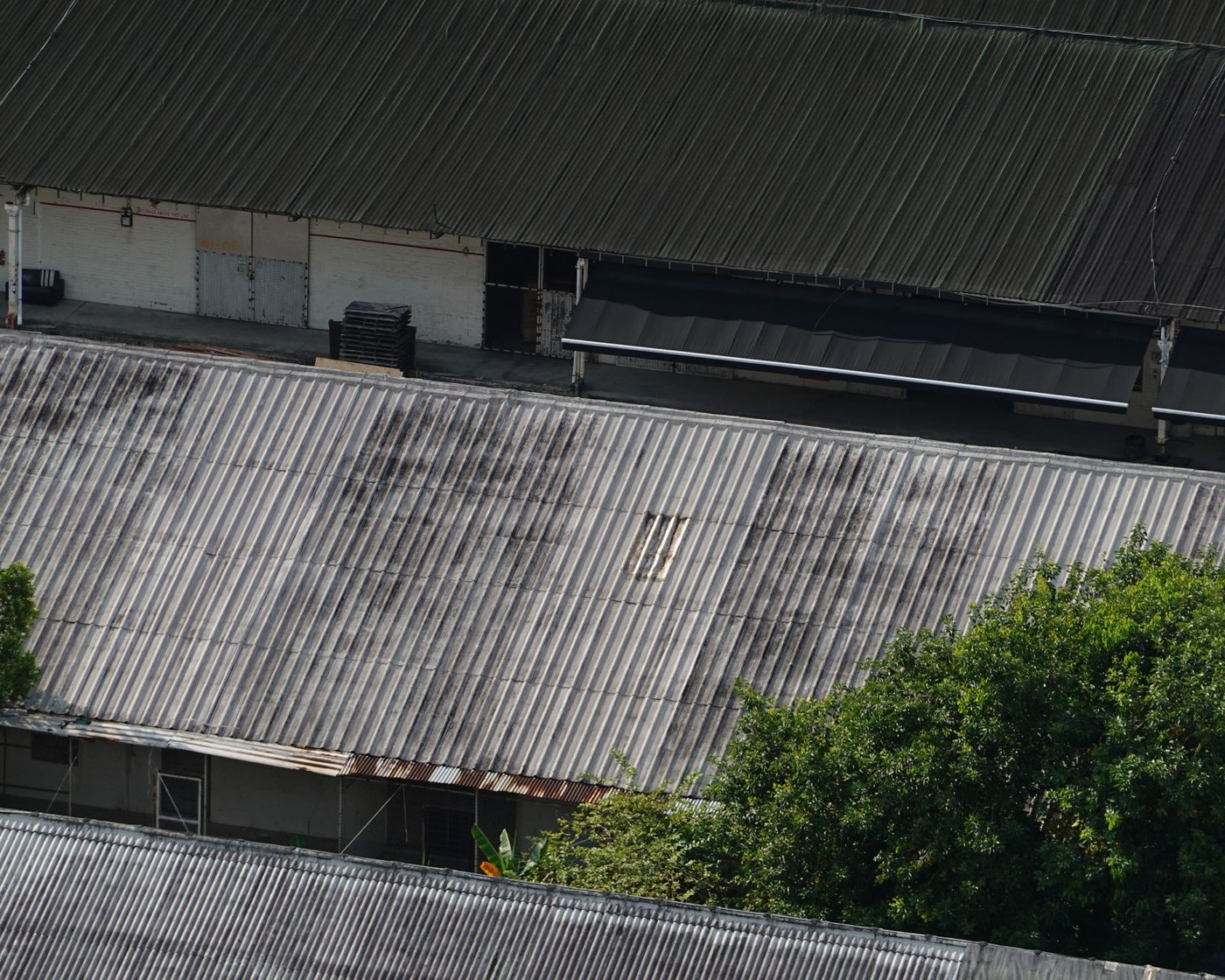
This is a roof inspection checklist for a school or a campus. It assumes several roofs of different ages and systems on one site, which is the normal situation rather than the exception.
Run it in the autumn, so that what you find can be specified over the winter and built in the summer holiday.
Before you go up
Walk the site at ground level first with a roof plan, marking every roof area including the low ones over corridors and canopies. On an older site this usually finds areas nobody has on record.
Agree access, safeguarding and a named site contact. Keep ladders and hatches secure throughout.
Area by area
| Record for each roof area | Why |
|---|---|
| A number, fixed forever | So findings can be located and compared |
| System and apparent age | Areas differ, and so do their remaining lives |
| Construction date if known | Extensions date the junctions that fail |
| What is below it | A leak over a corridor differs from one over a store |
| Access route | How anybody gets there to repair it |
The roof surfaces
| Look at | What a problem looks like |
|---|---|
| Drainage | Blocked outlets, missing strainers, standing water, no overflows |
| Gutters, particularly internal | Debris, moss, sagging, open joints, staining below |
| Seams and laps | Edges lifting, dirt lines, hand applied mastic |
| Perimeter and edge metal | Open joints, lifted sections, loose bars |
| Upstands at parapets and walls | Membrane pulling away, a gap at the top |
| Junctions with extensions | Where two roofs of different ages meet |
| The open field | Splits, punctures, blisters, scuffs |
| Moss and organic growth | Common on shaded school roofs, marking damp areas |
The details that fail here
| Look at | What a problem looks like |
|---|---|
| Rooflights and lanterns | Crazed, cracked, flashing lifted, condensation inside |
| Canopy and walkway roofs | Ponding, blocked outlets, corrosion at fixings |
| Plant enclosures | Ponding on a small flat roof nobody visits |
| Soil vents and extracts | Collars split, flashing slipped |
| Lightning protection | Tape fixed through the membrane, loose clips |
| Ball guards and netting | Fixings into the roof, damage from impacts |
The equipment
| Look at | What a problem looks like |
|---|---|
| Boiler flues and terminals | Staining, corrosion, sealant failed at the base |
| Ventilation and extract units | Curbs sealed with mastic, panels left open |
| Condensate discharge | Running onto the membrane, a permanently damp patch |
| Solar arrays | Debris at the upwind edge, ballast moved, worn membrane |
| Cable and data runs | Resting on the membrane, fixings through the roof |
| Aerials and masts | Fixed through the roof without a detail |
Inside the building
| Look at | What a problem looks like |
|---|---|
| Corridor and hall ceilings | Stains, sagging tiles, water marks near a junction |
| Classrooms below flat roofs | New staining, damp at a wall head |
| Plant and boiler rooms | Trays, buckets, standing water |
| Store rooms | Damage nobody has reported because nobody is in there |
| The leak log | Where it dripped, when, and in which weather |
What to do with it
- Walk the site at ground level first. It finds the roofs nobody has on record.
- Number every roof area and keep the numbering. A single grade for a campus means nothing.
- Inspect in autumn, specify in winter, build in summer. The window is known years ahead.
- Keep a leak log between inspections. Date, room, weather. Five columns.
- Give the low level roofs their own attention. They are the oldest and the most disruptive.
Want the reasoning behind this? Read how building type changes the roof and what an inspection program covers.
Walked by Date Roof
Common questions
What makes a school roof different?
It is usually several roofs rather than one. A campus that has grown over decades carries flat roofs, pitched roofs, link corridors and extensions of different ages and systems, each with its own remaining life, and treating them as a single roof hides all of the useful information.
- Multiple systems, ages and construction dates on one site
- Low level roofs over corridors and link blocks, often forgotten
- Extensions whose junctions with older roofs are a common failure point
- Occupancy that makes disruptive work impossible in term time
- A repair window limited to holidays, which must be planned ahead
The practical consequence is that a school needs an area by area record more than most buildings do. A single condition grade for the site is close to useless when the science block was reroofed four years ago and the original hall has not been touched since it was built, and a single budget figure will be wrong in both directions at once.
When can work actually be done?
Mostly in the holidays, which is both a constraint and a planning opportunity. The window is known years ahead, which means a school can plan roof work more precisely than almost any other building type, provided somebody starts the process early enough to use it.
- Summer is the only window long enough for major work
- Shorter holidays suit repairs and drainage work
- Contractor availability in summer is heavily booked
- Specify and tender in the preceding autumn, not in May
- Allow for safeguarding requirements on site
The common failure is leaving the decision until the summer term, by which point the good contractors are committed and the only quotes available are from whoever has capacity. Inspect in the autumn, specify over the winter, tender in the spring and the same work is bought better and done by people who chose to be there. Build the roof programme into the same cycle as the rest of the site's summer works, so the trades are not competing for the same compound and the same access.
What about access during term time?
It needs arranging rather than assuming. Roof access on a school site raises safeguarding questions, the routes often pass through occupied areas, and a contractor arriving unannounced during a school day is a problem for the school before it is a problem for the roof.
- Safeguarding checks for anyone on site during term time
- Access routes that avoid occupied teaching areas
- Agreed working hours, often outside the school day
- Ladders and hatches kept secure against unauthorized access
- A named site contact for every visit
Plan the inspection itself for a holiday or an inset day where possible, which removes most of these constraints at once and lets the inspector work systematically rather than around a timetable. Where that is not possible, agree the route and the hours in writing beforehand and expect the site team to hold you to both. Record every visit in the site log with the names of who attended, which the school will need anyway and which answers any later question about who was on the roof.
Which parts of a school roof get missed?
Low level flat roofs over corridors, link blocks and single storey extensions. They are rarely visible from anywhere, they are often the oldest part of the envelope, and they sit directly above circulation space where a leak is most disruptive to the day.
- Flat roofs over corridors and link blocks
- Canopy and covered walkway roofs
- Junctions between an extension and an older building
- Plant enclosures and boiler house roofs
- Roofs only reachable from inside a locked area
Walk the site at ground level with the roof plan before going up, marking every roof area you can see including the small ones. On an older campus this routinely turns up two or three roof areas that are not on anybody's record at all, usually over a corridor that was added at some point nobody can date. Photograph each of these small areas annually in the same way as the main roofs, because they tend to deteriorate unobserved and then fail all at once.
What should a school keep between inspections?
A leak log. Every drip reported by a caretaker or a teacher, with the date, the room and the weather. It costs nothing to keep and it is the single most useful document a school can hand to an inspector or a roofer.
- Date, room and weather for every leak reported
- Whether it has happened before in the same place
- Photographs from the caretaker, taken on a phone
- What was done about it, if anything
- Kept in one place rather than in several inboxes
Site teams almost always hold this information informally, and it almost always disappears when somebody changes job. A shared sheet with five columns turns it into a record that survives, and an inspector reading twelve months of it will know where to concentrate before setting foot on the roof. Give the caretaking team the sheet rather than asking them to report through a system, since the record only survives if the people who see the leaks find it easy to fill in.